Article copy
French thinker Georges Gusdorf, in his superb comparative history of the French and American revolutions, circa 1988:
The Constitution of the United States is a gentlemen's agreement between a number of the nation's representatives, devising quietly a text meant to ensure the good management of the federal State's commons. The document would pass into law only after approval by [...] each of the States, and ratification by at least 9 States over the 13. An opinion campaign thus ran for a few months, in 1787-1788, where both partisans and adversaries of a strong central government confronted their views. (...) the writings of the polemicists stemmed from good common sense and a quality of views that contrasts with the hateful and apocalyptic violence of the French revolutionary pamphleteers. In particular [...] The Federalist, an exegesis and a profound justification of the new law, remains after 200 years a classic of the United States constitutional law and political science, whereas the collection of Pêre Duchêne and that of l'Ami du Peuple [The ghastly Marat's1 "The People's Friend"2 newspaperish filth—DF] belong to the museum of the horrors of rhetoric—or that of the rhetoric of horrors.
(...)
The Constitution of the United States is a work of reason, negotiated by an elite of well-wishing men, caring for the common good, whereas the French revolutionary constitutions are the products of exalted passions. Hence the resilience of the first, and the extreme fragility of the latter, doomed as they were under the pressure of the street, in an End of the World atmosphere.
(...)
America's insurgents took arms to ensure a freedom they already owned. Whatever the emotions of the various crisises, the violence of the popular revolts and the valor of the fighters, liberty, in the United States predates 1776-1777, 1783 or 1787; it is not conquered over the "tyrant" of London; it does not preside to the instauration of a new order of things [...] if the colons revolted, it is because they felt they were in risk of being deprived from prerogatives that had always been theirs. Here, without a doubt, lies a fundamental difference between [the revolutions] of America and that of France.
(...)
Upon the ratification of the Constitution, the state of Massachusetts, who fears the excessive use of power by the central government, only agrees under the condition that a series of amendments securing the citizens' fundamental liberties (religion, press, assembly, petition, the right to bear arms, trial by jury, etc.) would be added to the federal law. Voted in December 1791, these ten amendments, that compose the Americans' Bill of Rights, enounce rights they were already enjoying for a long time; they went without saying and that is why they were not explicitly written into the Constitution; indeed it goes even better saying it, yet they were not a conquest but merely an acknowledgment of a legal and actual situation that wasn't threatened.
(...)
Teaching in a US university, I asked my students (...) to establish a list of the major events that marked out, in their own opinion, the history of the West. Two of them cited as the initial date the year 1492: Columbus' discovery of America. One could argue that the question had not been properly understood, but these answers are characteristic of a state of mind; for these young Americans, the invention of their continent marks a new beginning in the history of the world.
Translated by yours truly from "Les révolutions de France et d'Amérique: la violence et la sagesse" ("The Revolutions of France and America: violence and wisdom") by Georges Gusdorf—putting to rest a few of the most vicious French revolution falsities, thoroughly debunking any notion that the American revolution owed anything to French Enlightenment thinkers (the official Party line in France, incidentally) and that, as Jefferson quickly figured out, far from being similar in nature and spirit the French revolution was and remains America's war of Independence evil and totalitarian twin, and a true antithesis of the Great Experiment.
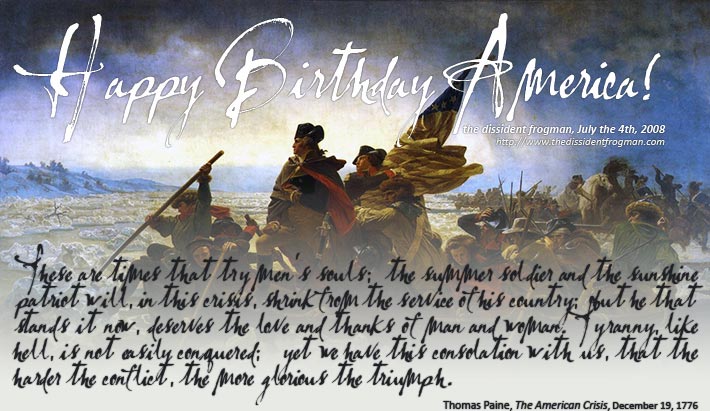
4th of July, birthday of a new beginning. Happy birthday.

Comments
Comments thread (10)
3578 - Proof
Proof Stockton, Callifornia, USA
Bon jour, Monsieur Frogman! Thanks for the birthday wishes!
May gentlemen of such stature rise up from amongst your brethren and let freedom ring throughout the land!
3579 - TooTall
TooTall Utah
Thanks DF - For our French brothers the first sentence in the Declaration of Independence:
Lorsque, au cours des événements humains, il devient nécessaire pour un peuple de dissoudre les groupes politiques qui ont connecté avec une autre, et d'assumer les pouvoirs de la terre, la séparation et de l'égalité de station à laquelle les lois de la nature et de la nature Dieu lui donnent droit, un respect décent pour les opinions de l'humanité exige que celles-ci doivent déclarer les causes qui les poussent à la séparation.
I hope it translates correctly, if not blame Google.
3580 - Ms.ManChow
Ms.ManChow Maryland
Yay! America!
Thank you for translating that.
Happy Independence Day!
3581 - 2hotel9
2hotel9 Western Pennsylvania
Over the years I have read several books that address this subject, most being romanticized drivel. Gusdorf goes into the underlying atitudes and perceptions of the two entirely seperate events.
To put it sucinctly, no government "gives" me rights, they are mine IN SPITE of government.
3582 - 2hotel9
2hotel9 Western Pennsylvania
Oh, excusez-moi!, s'il vous plait. And many joyous returns, Froggy!
3583 - Iwo Gina
Iwo Gina Maryland
Heartfelt thanks for the kind wishes, dear friend.
3585 - Lady Cincinnatus
Lady Cincinnatus Ohio & Kentucky
Thanks D. Frogman. I can't speak for the rest of your U.S. readership, but I consider you a true American Patriot in spirit if not in location! :)
3586 - BlueStarMom
BlueStarMom
Thank you for sending us this happy birthday message.
It is appreciated!
Just to let you know- my son just re-enlisted. He has deployed to Iraq 3 times.
I am very proud of him and all of our military.
(and NO John Kerry- he didn't re-up because he couldn't do anything else!)
Blue Star Mom and proud of it!!!
3588 - Iwo Gina
Iwo Gina Maryland
Blue Star Mom - I just want to express my gratitude to your son for his service to his country, and to you for your support of your son. God bless you both.
3590 - Valerie, Texas
Valerie, Texas
Dear DF,Merci beaucoup for the wonderful post on the 4th of July. Most certainly, DF, you are an American in your attitude, your outlook. Being American is a mindset, not always a matter of location at one's birth.
Blue Star Mom, please express to your son the gratitude and thanks of this Texas family. And thank you for raising up such a fine young man. Please let him know that his fellow Americans are proud of him and the job they are doing.